Monday, August 3, 2015

Ninilchik

Our next stop was only a short distance from Kasilof in the village of Ninilchik.  Like Kasilof, Ninilchik is a village that was settled by Russians.  It is not surprising since the US purchased Alaska from Russia so it stands to reason that there would be Russian influence.  Many of the family names are Russian and the most dominating structure in the tiny village is a Russian Orthodox Church.  The road leading to Ninilchik follows along Cook Inlet and the views are amazing.  Across the inlet, you can see four volcanoes.  About 50 miles away lies Mt. Iliamna and Mt. Redoubt both at 10,000 plus feet tall.  Both are active volcanoes although only Mt. Redoubt has erupted recently in 1989.  Both send out steam and Redoubt sends out ash from time to time.  It was a clear day and we could also see Mt. Augustine and Mt. Spurr about 80 miles away.  Mt. Spurr is over 11,000 feet tall while Mt. Augustine is only 4,025 feet tall.  These volcanoes are in what is known as the Ring of Fire that encircles the Pacific (including Hawaii).  Every day we have viewed them I was amazed all over again as they look ethereal to me.  They look like a painted backdrop one might see in a film, just unreal somehow.  I have tried over and over to capture them but just never quite got it right.

Ninilchik’s main focus (not surprising) is fishing charters.  Jim tried to get a place on a charter but since he waited so late to book, there was nothing available.  Still, we enjoyed seeing the boats return to the park each day and offload the catch of the day.  Everyone caught their limit of Halibut each day.  Most of the fish were in the 20 pound range.  Lynn Hodel told me they refer to them as “chickens” but actually these small ones have the best tasting flesh.  We only saw one large Halibut caught while we were there and it weighed about 110 pounds.


We had several wildlife encounters that were fun.  Take a look.

This is Mt. Redoubt.  No matter how many times I look across at the scene, I could not get over the blue color.  The mountain seems to rise directly from the water and blends into the sky behind it as well.  A picture just did not do it justice.
This is Mt. Iliamna.  Although it is not currently active, it is not dormant and could erupt again at some point in the future.
Ninilchik is a tiny village.  It sits at the edge of the beach of Cook Inlet.  They have a very busy dock area especially now with so many folks flocking to the water to catch Halibut.  The village was so quaint.  Many of the locals were selling hand crafts of all kinds.  Everyone was very friendly.
the Russian Orthodox Church stands on the bluff above the village.  It seemed fitting that it would stand watch over them, protecting them from the elements.
There were old boats of all kinds seemingly abandoned.  This one is a memorial to one of the local fishermen.
As we walked the beach, Jim spotted this Bald Eagle flying above us.  He was so beautiful and magnificent!  He soared on the wind currents looking for a meal I would bet.
After a few minutes, he was joined by what we think is a Golden Eagle or perhaps a juvenile Bald Eagle.  Whatever he was, he was quite a sight.  Oddly enough, they did not like each other and began to fly in a fighting posture.  At one point, the Bald Eagle turned upside-down and used his talons to drive the other bird away.
They were something to see flying high above us.
 Almost as if they were in formation, no?
Later, we saw this female Moose in a stand of trees and brush.  The light was less than ideal but she was not alarmed by our presence and I got plenty of shots to choose from.
The catch of the day was displayed by size.  The charter only takes out six fisherman but this day there were only five.  Now, we usually see Halibut pictured from the underside that is white.  But, when the fish is swimming along the bottom, it is the brown side that you see and incidentally that is where his eyes etc. are located.
After the fish are offloaded, the guides filet them and they are bagged for the person who caught them.  The camp has facilities to freeze and vacuum pack them as well.  I would have loved to have one of them in my freezer!

Kasilof

We left Hope heading to Kasilof.  Kasilof is just south of Soldotna on the Kenai Peninsula.  The entire peninsula is a haven for fisherman during the summer when the Salmon are running.  All the available campgrounds, RV parks and motels are packed with folks rushing to catch the prized Salmon and Halibut.  We wanted to stay in Soldotna so we could visit Lynn and Tom Hodel but there was no room at the inn.  No matter, Kasilof is just a short distance away.  We stayed at Crooked Creek in a park filled with fishermen.  I have to say our first sight of the park made me think, oh dear me.  It was run down looking and many of the rigs looked as if they needed a good bit of TLC.  There were all kinds of tents and tarps and lots of children running around shrieking and riding bikes.  To make matters worse, the sites were very narrow and the roads between rows very narrow too.  As soon as we pulled in front of our site, I had my doubts that we would be able to get into the site at all.  To our surprise, our neighbors immediately reacted and began helping us.  Our neighbors directly across from us came out too and moved not only their vehicle but also some of their belongings to give Jim more room to maneuver.  The folks next door likewise, moved bikes and other things so we had room to work.  Everyone was so nice and helpful.  When we finally got ourselves in place, the Mother from across the way came over with a plastic bag full of Salmon.  She asked me if we liked Salmon and if our rig had a kitchen (joking) and presented me with the fish saying, “welcome to the neighborhood.”  I felt very ashamed of myself for the negative thoughts and judgments I had when we arrived.  It just proves the old saying, “you can’t judge a book by the cover.”  In the following days, we really enjoyed our neighbors and were glad to be camping near them.


As you can imagine, the focus of everything was fishing.  We wanted to go fishing but unfortunately I was not able.  By now, I have developed a full blown case of plantar fasciitis in my right foot and walking has become a very painful action.  I was forced to seek out a doctor to find out what, if anything could be done about it.  As I suspected, there is very little that can be done beyond getting orthotics and a shot in the heel.  Well I can tell you, getting a shot in your heel is not something I would ever do again.  To say it hurt is the understatement of the year.  I think I was heard about a mile away hollering!  As a result of my foot, we were not as active as we had hoped.  Alas, Lynn and Tom were busy with family issues and with my foot so painful, we did not get to visit with them either.   Still, we managed to see some beautiful country.  One afternoon we took a drive up to Captain Cook State Park where we were thinking we might camp at some point.  It was beautiful no doubt but the camp sites are too small for our rig.  Nevertheless, it was a wonderful afternoon and of course, I took pictures.

Along the way, we passed a lovely lake.  In the distance, there was a family of White Swans.  I used my zoom lens to get a picture of these lovely birds.
The campground had a picnic area that sat on a bluff overlooking the Cook Inlet.  Below us was the beach -- yea! the beach!  The day before we visited one of the local brewpubs (Jim's goal, remember?) and met several really nice young men in the 25-30 age range.  One of them told us he had been in Alaska about seven years now.  He is an electrician and works on the oil/gas rigs.  He works 7 days on/7 days off and makes very good money.  He said anyone who had good work ethic and skills could make a nice living.  From where we stood, we could see a number of rigs in the distance.  I thought of the man we met.
The beach area reminded us of the beach in Northern California.  Unlike the sandy beaches of Florida or the Carolinas, the beach is rocky and the rocks are dark grey and black.  In the distance, Chigmit Mountain in the Alaskan Range rose like a ghost on the water.

 The sun was quite warm and it was nice to see children trying to fly kites.  This little fellow ran and ran, often falling down but quickly getting up refusing to give up until his kite was floating on the wind.
On our way out, Jim spotted this Moose beside the road.  This fellow has the beginning of his antlers now covered in soft velvet.  One day soon, they will be magnificent.  I hope we are still in Alaska and get to see one with a full rack.

Hope, a Hidden Gem

Our new destination is Hope and the Porcupine Campground.  We are excited about this move as this will be the first time we have dry camped in the Open Range.  This state campground has no on-site facilities so we will be totally self-sufficient.  Within the camp, there are toilets and scattered throughout are old-fashioned hand water pumps where we can replenish our drinking water supply but nothing is available for us to hook-up too.  We are not worried at all about our ability to be self-sufficient as we have generators to recharge our batteries and plenty of water in our fresh water tanks.  Still, it is our first time in this rig and we are excited.

As we left Cooper Landing, the skies threatened rain and it was not long before the threat turned to reality.  The road to Hope is a two lane road that winds along between the mountain and the water.  For a part of the journey, we rode beside the Six Mile Creek.  It is a lovely, clear creek that would one day soon be full of Salmon.  We traveled deep into a lush forest feeling like we were totally alone in this wilderness.  Gradually, signs of life emerged as gravel tracks turned from the road and disappeared into the trees.  Rarely could we even glimpse the cabins set back in the trees or nestled on the back of the water.  Folks up here must really value their privacy.  At some point along the way, the creek ended and the water of Turnagain Arm came into view.  I get a bit confused when it comes to these bodies of water but basically as we came south out of Anchorage, we traveled around the Turnagain Arm which if fed by the waters of Cook Inlet.  In any case, as we traveled upward to Hope, the Arm was along the road and it was low tide.  There are signs all along the way warning folks not to walk out on the flats when the tide is out.  This mud acts like quicksand and is dangerous sort of like, look but don’t touch!

At the end of the road, we arrived at Porcupine Campground.  It sits at lands end, high above Turnagain Arm and surrounded by the Chugach Forest.  Our site is nestled deep within the Birch trees.  The overhanging trees and dense vegetation around the site create a shaded haven for us.  All around are plants with berries and flowers that we have not seen before.  As it turns out, the girls are allergic to them.  Poor dears are plagued with runny roses and lots of sneezes as the days wore on.  We hurried to set-up camp as the rain was beginning to come down in earnest.  We settled in for the night, snug as a bug in a rug.

How different it is when there is nothing like TV to fill the silence of the evening.  We have a 12 volt DVD player so I put on some soft music and we played Mexican Train.  How nice to be focused on each other instead of the TV.  Since darkness does not come until well after midnight, we went to bed in the twilight hopeful that tomorrow would bring sunshine.


It was hard to tell whether the sun was shining or not the following morning, but it was indeed.  We wanted to explore the village and check out the fishing too.  We also wanted to see the bore tide.  I never head of it before but a bore tide is created by the constriction of a tide rushing up a narrow estuary such as Turnagain Arm.  So Cook Inlet and the Arm reaches low tide and as the tide returns, instead of a gradual increase such as we see at the beach, it rushes into the Arm much like a tidal wave only not usually so powerful.  We read about tides that come in as high as fifteen feet and can sweep animals or people away if they are not very careful.  One local told us about a time he witnessed a moose being swept away by the bore tide.  I cannot imagine such a tide and looked forward to seeing this phenomenon.  There was much to see during our stay in this wilderness.  Here are some pictures to enjoy.


This view is of the Turnagain Arm from our campground.  To the right of the picture is the location of the village of Hope.  The tiny village has a deep history and is a big destination for fishermen hoping to catch salmon.  The creek flows into the Arm and is full of fish leaving the salt water for the fresh water stream.  The arm is narrow where it meets the Cook Inlet and widens as it flows inland.
 The village of Hope is full of all sorts of quaint buildings and cabins.  This cabin houses a unique gift shop and all sorts of general merchandise.
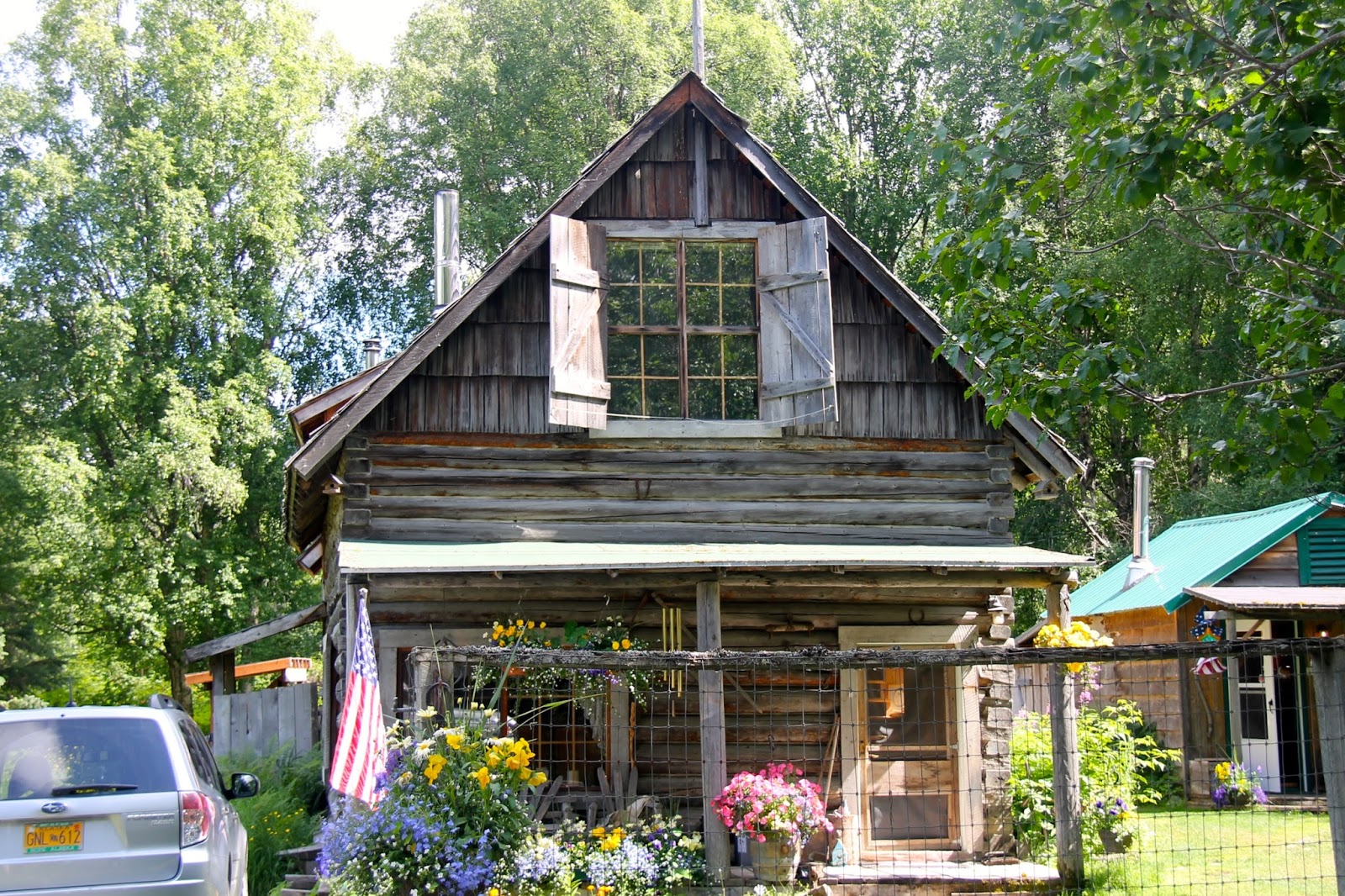
This cabin is typical of many we have seen in Alaska.  Most of the ones we saw in Hope were sadly in need of paint but then if they were painted, it would ruin their "aged" look.
As you can see, most of the cabins are basically one-room.  They are mostly quite simple structures and keeping them small ensures warmth in the winter.  One the side is usually a nice pile of fire wood.  There is still time for this owner to increase his wood or he might be cold in the winter.
You can see that there is quite a crowd here mostly fishermen flooding into the creek.  The Cafe in the forefront was part of a two building structure connected by a covered walkway.  The front building housed a cafe that served wonderful food consisting mostly of veggies grown in their own garden.  The second building was a pub bar that opened late in the afternoon.  They serve local beer and have entertainment most nights that draw folks from all over especially on the weekends.  One local told us that the crowds are hard to take but bring in much needed revenue to take them through the winter months.  She said with the noise from the pub and the smell of rotting fish from the creek it was pretty awful.  They have a "take back the town" party the first weekend after the season closes.  Hmmm, I felt a bit like an interloper.

 Fishermen and women trying their luck.  They were catching Silver and Red Salmon.  The banks were lined for yards upstream.
Overhead, Sea Birds of all sorts circled on the winds watching for someone to catch and clean a fish.  In Alaska, when you clean a fish you return the "leavings" to the running water where it was caught.  The fish feed not only us but also the birds, bears, aquatic animals and then nourish the land too.
 The groups of birds fought over the scraps to get a meal.  Their screeching and squeaking could be heard all over town.  The local I spoke with told me that if it were not for the birds, the smell of rotting fish would be unbearable.  All I could think of was, the circle of life is truly amazing.
This is Turnagain Arm at low tide.  The Arm has a high and low tide that corresponds to Cook Inlet.  The restricted entrance of the Arm creates what is called a Bore Tide.  We have watched it three times and each time it is amazing even though the height of the tide is not big at this phase of the moon, it was still amazing to see the water rush forward like a tidal wave does.  At times, it is just as powerful and can be as tall as 13 feet.
Our first Bore Tide viewing.  Here is the front edge of the tide as it moved across the Arm.


Our second viewing.  The pictures do not do the tide justice but when you see it, the power of the water is amazing.  What is really amazing is that the tide is linked to the low tide of the Cook Inlet in Anchorage.  About two and a half hours after low tide, the Bore Tide starts in the area of Hope.  We could watch the tide from the campground and then jump in the truck and hurry down the Arm and see it again as it flows upward.  About forty five minutes after Hope, it can be viewed from Bird Point and later still from Bulaga Point.  We were lucky to see it from Bulaga Point too.


Sunday, July 19, 2015

Cooper Landing

We said goodbye to Portage Valley and headed south down the peninsula.  Our next destination is Cooper Landing where we would stay at a lodge and RV park on the Upper Kenai River.  Here we were deep into bear and fishing country.  While Cooper Landing is a community, there really is no “downtown”.  The businesses are focused on outdoor adventures of all kinds.  The lodge sits high above the Kenai River.  They have a large patio area that afforded us a restful view of the blue waters of the river and the deep greens of the forest areas.  All around are signs reminding everyone that we were in bear country and to take all the usual precautions about food  and anything else that can attract them.  We were distressed to learn that last year the state conducted two bear hunts as the population had become too large.  Each hunt took 250 Black Bears!  I cannot imagine how they could take that many and still have bear left but apparently they did.  From the park, with binoculars you could see bears on the mountain side eating berries.  As the berries of all kinds ripen, the bears gorge themselves in preparation for the winter sleep.  Every time we went out with the girls to walk into the forest, I felt apprehensive and imagined that at every turn a Black Bear might appear.  Thankfully, that did not happen.

Jim decided to take a fishing trip.  Here on the Upper Kenai, no motorized boats are allowed.  So guides take folks out in boats that drift with the currents.  You can fish from the boat or you can get out and use waders and fly fish.  Here, it is catch and release only; plus, there were no Salmon as of yet.  There were lots of birds that follow the fisherman in hopes of stealing a meal.  There was a Bald Eagle that sat in the same tree each day watching for an opportunity to steal a fish.  As they passed, Jim had a fish on.  The Eagle took flight, screeching as he circled overhead.  This time however, he did not get the Rainbow that Jim had on his line.  Jim had a good day and caught Rainbow, Grayling and Dolly Varden.


The weather was rainy while were there so picture taking was poor.  Here are the only shots we took.

The RV Park sits in a valley at the base of these mountains and above the Upper Kenai River.  This picture was taken at 11 p.m. in the evening.  The sun was fading behind the mountain leaving only the top in view.  Jim went out and took a picture with his cell.  Turned out pretty good.  Even after all this time here, we still are amazed that the sun is still shining near midnight.
One of the Rainbow Jim caught on his fishing adventure.

Portage Valley 3 - The Sun Finally

After spending the morning and early afternoon walking around in showers, the sun finally broke through the clouds and the winds blew away the mist.  The landscape under the sun sparkled and the true colors were bright and deep.  What a difference the blues and greens were under the sun.  We hurried to visit all the different glaciers to see how they looked.  The difference is remarkable.

What a difference the sun made.  The glacial ice glistened blue under the sunlight.
The mountain and glacier was the perfect backdrop for this pretty lake.
These two glaciers a easily seen from the road that goes through the valley.  At the end of the valley is the Anton Anderson Memorial Tunnel.  It is the longest highway tunnel and longest combined highway/railroad tunnel in North America at 13,200 feet.  It uses a computerized system to stage the types of vehicles through the tunnel from trains, 18-wheelers, cars to motorcycles.  When the train is due, the road closes to traffic.  When cars are traveling the tunnel, it is one-way only.  So for fifteen minutes, cars would go to Whittier and the next fifteen cars return.  It is the only way to get to Whittier except by boat.  Originally, the tunnel was only for trains but was expanded to allow vehicles to give land access to Whittier.  Whittier has a port where you can take a ferry to Valdez so the tunnel is an important link allowing land traffic to access the ferry system.  As it is expensive to go through the tunnel so we elected not to go but rather to focus on the valley instead.

A few clouds began to form before the afternoon was over.  Here, Portage Glacier caught the mist as if it were a bowl of snow.
The four of us enjoyed walking through the forest and along the lake shores.  Savannah and Charlotte are like sled dogs pulling Jim along.
Here is a section of the Blue Ice Trail that winds throughout the valley.  It was a lovely way to experience the forest and view the glacier too.
Our final view before we said goodbye and headed out.

Portage Valley 2 - Small Things

We planned to spend this day hiking and enjoying all the sights but Mother Nature decided to send us rain.  Like yesterday when we arrived, the clouds hung low and the air was thick with mist.  We could not even see the glacier just behind where we were parked.  Since we only had this one full day to see the area, we dressed for the weather and headed out.


All the streams here in the forest are very important to Salmon of all kinds.  The Salmon come up the streams to spawn at different times during the summer depending on the type.  There is a Fish Trail that has been developed that allows visitors to see the Salmon in the shallow, clear streams.  Unfortunately, it would be another two weeks before any of the Salmon come into this area.  Well no matter, we could still enjoy walking the trail and who knows what we might see.  As we walked along, the colors and patterns of the plants and flowers began to catch my eye.  I started to really look at these small things that are beautiful in their own right.  I saw how the rain drops glisten on the leaves and flowers.  Now, I am not a real photographer but perhaps you will enjoy my pictures anyway.

At the beginning of the trail, there was an area with placards explaining the life cycle of all the different types of Salmon.  It will be another ten days before the Salmon arrive here in these streams.  I bet that would be something to see.  The trail wound beside this stream and crossed back over it many times.  Overhead, the clouds hung low and the rains came and went.
I began to notice how the moss grew on the bare limbs of trees and bushes that overhung the stream.  It was as if the moss formed a sleeve on the branches.
The ground was covered in many places with lichens.  The texture and coloration was a perfect backdrop for these delicate, green plants.  Simple yet complex in color and texture.
The raindrops formed delicate jewels on the leaves.  If we brushed against them or the wind disturbed them, the water would cascade down the surface and pour into the thirsty ground below.
These tiny, yellow flowers grew beneath the bushes.  Here, the rain had formed tiny droplets on the stalk of this plant.  I wish I knew the names of them.  So tiny, yet very hardy to survive in this environment.
 These tiny berries were all around.  They promise meals for the bears I suppose.
This plant had tiny cones.  Their rust color stood out against the deep greens.
Here is the same plant.  You can see the immature cones with some of the mature ones.  They were everywhere.  I wonder if they can be eaten by the bears?
Fireweed.  This is a common plant seen all over Alaska.  The plant flowers beginning at the bottom and gradually moving upward until the top has blossomed.  The locals say once the top flowers, it means winter is just around the corner.
These tiny white clusters of flowers grew on bushes close to the ground.  There were only a few of them and their stark, white flowers really stood out.
This tiny flower reminded us of Orchids.  Jim had quite a collection of Orchids in Singapore so this little guy amazed us.  Interestingly enough, Orchids grow in all kinds of environments even in the cold North where there is lots of snow.  It looks so delicate but is actually quite hardy.
These tiny berries grew close the the ground beneath the protection of the trees and bushes.  They look like tiny strawberries or raspberries.  I asked what kind of berries they were and was told they were Salmon Berries.  Hmmm, not sure I buy that one.
Scattered here and there were these plants.  They look as if their leaves have already begun to change colors signaling that fall is not far away.  But then again, perhaps this is how they grow.
These leaves really caught my eye.  The perfect, tiny rain drop nestled in the center of the clusters looked like jewels.  Even when the wind blew, the droplets did not fall but stayed firm in place.  Amazing.
When I was a child, my Father would take me fishing on lazy summer days.  We often would see turtles lined up on logs sunning themselves.  The moss on this log evoked images of such turtles.  You can see the reflection of other bushes in the still water.
Another variety of berry glowing among the bushes.  
As the trail ended, we found ourselves standing before a lovely lake.  It was so still that the water reflected the trees perfectly.  A peaceful end to a lovely hike.