Sunday, August 5, 2018

Theodore Roosevelt National Park, a wonderland

The old saying, "a picture is worth a thousand words" is true.  I could write a book about how we were impacted by the beauty of the park.  We spent three hours plus driving the loop road (and repeating part of it), stopping and taking pictures and watching wildlife.  So many folks go into the park with the only goal of seeing wild animals.  While it is nice to see the bison or horses or prairie dogs, it is the land itself that draws us in. The striations of color in the formations and the vistas of beauty to be seen, well it is worth the time to take it all in.  When we entered, the ranger at the gate said something that hit us both.  As we drove away, she said "enjoy your park".  That says it all.  Like the song, "this land is your land, this land is my land...."  Enjoy a few of the many pictures I took of this wonderful place.

We saw two groups of "feral" horses that day.  The horses are commonly called "wild" however, wild refers to horses who have never been domesticated.  Feral are horses or any animal who have been released into the wild and thus are referred to as feral.  I never heard that before but it makes sense.


There are several Prairie Dog Towns" located in the park.  These tiny creatures are funny to watch and we could hear their squeaking as we enjoyed watching them.

There are hundreds of these
mounds forming their "towns"

When they are alarmed, they
disappear into the holes and can
reappear in another

These guys were in another "town"
but cute as a button


The landscape is amazing.  It reminded us of a combination of painted desert and canyons in Utah.


Red color at the top glowed in the sunset later in the evening


The formations are raw looking.

There were campgrounds near here, a lovely place to be.

This formation reminded me of a lion ready to pounce.

Medora, Salute to Theodore Roosevelt


The road to Medora was an easy drive; smooth and straight as an arrow.  As we drove along, the landscape began to change from flat prairie to more rolling, green hills.  The ever present corn and soy beans were still there as were the Sunflower fields.


Any time we drive from place to place, we are bound to see all sorts of billboards and other things designed to lure you into a stop.  Sometimes, you pass something that has no explanation like this piece of sculpture.  It looks much like an eye to me.  There was no explanation but it certainly caught my eye and demanded a picture.  Perhaps is pays tribute to all the migratory birds that go through ND.

Medora, population 132 is the gateway to the Theodore Roosevelt National Park and the number one tourist destination in ND.  Imagine that!  It is a tiny town but filled with pride and patriotism for its country and the history of this town.

Our final night here, we went to a dinner and musical production called Medora. It is held at a venue on top of a bluff where an amphitheater has been created for the show that has been in operation for 60 years+.  We were told that they have served as many as 1200 people at a time!  How can a town of 132 support this I wondered.  Well, volunteers from all around come and donate their time for a week, imagine that.  The dinner features "fondue steak" as a signature dish.  They actually put steaks on pitch forks and put them in oil or seasoned broth, I am not sure which but the result is delicious.  The show was very well done and entertaining.  As the show was beginning, on the hills above we could see two large Elk.  Now, it was not by chance mind you that they were there.  Somehow they had "trained" these two to come everyday at this time.  They put some food up there and as soon as they open the gate, the Elk make a beeline to get the food.  However it happens, it was amazing to see.  The show had many elements that honored not only our country and her veterans but also Theodore Roosevelt, conservationist whose efforts ensure our nation's natural wonders can be enjoyed for years to come.

Maltese cross 
Maltese cross cabin
If you remember your history, you know that he lost both his Mother and wife within hours of each other.  Suffering from profound grief, he left his infant daughter with his sister and made his way West ending up in ND at Medora.  He lived, worked and wrote in what is now known as the Maltese cross cabin.  Teddy and his companions used spent rifle cartridges to pound the Maltese cross into the end of one of the exterior logs of the cabin which was moved to the grounds of the visitor center of the park that bears his name.

Teddy loved North Dakota.  He found peace and solace here living the life of rancher, hunter and explorer.  It is here in Medora that his ideas about conservation and the “strenuous life” took root.  Without his experiences here, we would not have the National Park system that is so important to us personally and to our country.

We started our visit to the park at the visitor center where there was a great deal of history about Teddy and people he met and worked with in Medora.  People like Marquis de Mores and his wife.  They shared the love of the ND land and the life of peace it brought.  I could go on and on but this is a blog not a history lesson, right?  One of the things that struck me at the museum was a statue of Teddy astride his horse.  It is made from strips of wood, painstakingly put together to form not only the horse but the figure of TR as well.  The figure is wearing clothing that he wore on a daily basis.  It was an amazing work of art.


After the museum, we joined a line of traffic waiting to proceed into the heart of the park.  Road work is necessary for sure but it can be a pain in the neck when one wants to get going.  The first 13 miles of the road into the interior is under repair so we had to wait for the pilot car to lead us through to the other side.  But once we were in the park, well, you have to read my next blog to find out!

Thursday, August 2, 2018

Lewis and Clark Corps of Discovery Expedition

Lewis and Clark are well known historical figures to all of us along with Sakakawea who’s place in history has expanded over the years.  This area of North Dakota is especially important in the Lewis and Clark story because in 1804, it was the site of Ft. Mandan where the expedition spent its first winter.  Near that site is the Lewis and Clark Interpretive Center.  Here the story of their journey is detailed.  Outside the center stands three large statues of Lewis, Clark and the Mandan Chief Sheheke-shote (White Coyote).  With winter fast approaching and food supplies dwindling, Lewis decided they would build a fort here on the banks of the Missouri where they would shelter during the long, harsh winter ahead.  Enter the Mandan people and their wise chief.  He is quoted as saying, “If we eat, you shall eat; if we starve, you shall starve also.”  It was quite fortunate that the expedition encountered the Mandan else they surely would not have survived the winter.  The Mandan supplied them with bison meat, corn, squash and buffalo hides and in return they received the “trinkets” that Lewis brought along to trade. 

As is often the case, happenstance plays as much a part in historical events as does good planning.  Lewis planned for many things that were needed for the expedition but he also failed to plan for many of the “human” necessities such as warm blankets and food. It is said that he only brought 15 blankets for a group of 50 more or less.  Pin Head!  So without the buffalo hides that the Mandan provided, well let’s just say their numbers would have decreased.  Food was another item.  Many of the recruits were new to the army, young single men.  Yet these same men were responsible for providing, preparing and cooking their own meals, really?  When I think about it, it is nothing less than a miracle that they made it to the Pacific and back alive!

It was their good fortune to meet Toussaint Charbonneau, a French Canadian explorer/trader (and buffoon, but I digress) who became a member of the expedition. He was also the captor-husband of Sakakawea.  Sakakawea (Bird Woman) was a Shoshone woman who had been captured by the Hidatsa and sold to Charbonneau for one of his two wives.  When you look closely at the story, she never really had a choice in accompanying the expedition, however she took a keen interest in helping them along the way.  She was a hardy soul for sure.  Before they set out, she had given birth to a son named Jean Baptiste.  She carried that baby on her back the entire way.  Good golly, I cannot imagine how difficult that must have been.  Unlike her legend, she did not guide them but her worth was great.  When they encountered the Shoshone further along, it was a great surprise to find that their chief, Cameahwait was Sakagawea’s brother.  She was able to get him to supply horses that were badly needed.  Without her help, their journey may never have been completed.  You Go Girl!


 Okay, okay enough history lesson.  After the center, we made our way to Ft. Mandan.  They do not know exactly where the fort was built but know it was within a 10 mile radius of this site.  The fort itself was intended to serve them on the return trip, however it had burned before they returned.  So the fort we visited is a reproduction built using the journals that told of the size, timber used etc.  It is quite small and considering 50 or so people stayed there, yikes it must have been chummy.  In the journals, they tell of the snow and how temperatures dropped to 45 below zero!  (See how important blankets were?)

We joined a guided tour and the ranger was quite knowledgeable. We saw the quarters where they spent their time writing in journals, repairing and making rifles, axes and knives etc.  They slept in the loft above the room and prepared their meals in the fireplace.  Here you see a store room showing the varieties of corn the Mandan provided for them along with beans and a type of squash.  On the right, are examples of items that were used for trade.  A note about the tallow candles, they are made from animal fat.  During times when they were desperate for food, they ate them along with many of the dogs they brought along and horses they acquired from the Shoshone.  Desperate times.....  Of the dogs they brought along, only one Newfoundland dog named Seaman made the return trip.


 Among the rifles that the group brought along, two were especially important.  One, an air rifle was surprisingly important.  Nothing like the ones we see today, it had a reservoir in the stock to hold air that had to be pumped into it.  They used a pump that took about 30 minutes to complete the task.  What was so important about that?  Well, the Indians were familiar with muskets etc. and knew that after each shot they had to be reloaded.  This rifle could shoot eight shots without stopping.  So any time they met with the Indians, this gun would be taken along and demonstrated to encourage them to be "friendly". The other important gun was this large rifle shown in the pictures.  The ranger called it the "big bertha" (the gun not him).  It weighs quite a bit and fired all sorts of things.  It was kind of like a shrapnel gun.  It was mounted similar to a cannon and fired for maximum effect.

One last tidbit and I will stop before you fall asleep.  The object you see in the ranger's hand that looks like a stick with twine on it, but it is actually a tobacco pod.  Tobacco was one of the items for trade.  The processed tobacco placed inside a type of pouch and then the twine was wrapped around and secured.  It was a great way to introduce the joys of smoking to the unsuspecting Plains Indians.  In his other hand is a string of glass beads.  The Indians had to use shells and other natural things to adorn their dresses.  The glass beads were of great interest to them.  On another note, they also used the metal from pots they traded for to make beads.  The pots they said made the food taste metallic so they cut them into squares or strips and used them to decorate their dresses.  Imagine the sound of the metal clinking as they danced.  No big base speakers for them!

Tomorrow we will travel to Theodore Roosevelt National Park.

Note:  in the previous post, I made a mistake.  The lithographs and sculptures were actually from the Lewis and Clark center, not the museum.  My bad.

North Dakota, Ancient Wonders

We finally reached North Dakota.  We set up our mobile house in a park located near the village of Monoken.  I laugh as I call it a village as it certainly qualifies as a ghost town.  We took some time to investigate this home of about 62 people in hopes of learning what brought the community together and why it died.  It was really a pitiful place.  The post office, a small squat white building has long been closed.  The town hall looked much like a church.  It was also painted white but was boarded up and the prairie grasses had begun to lay claim to the land once again.  There were a few homes and mobile homes that looked like they might be inhabited but mostly the homes were tired, clapboard structures that the prairie winds have robbed of their paint and the weeds and grasses have begun to weave a cocoon over them.  I tried to picture in my mind what it might have looked like in its heyday with people coming and going.  The only structure that is well kept is the elementary school.  There was work going on getting it ready for the beginning of the new school year.  It stands as testimony that life in this place continues and the spirit of the west and why people came is very much alive.

The nearest city is Bismarck about 10 miles from where we were camping.  It has all the usual suspects of civilization, Walmart, Kohl’s, McDonald’s and others but we weren't interested in any of these.  We wanted to learn about the state and the people who first came here.  We turned our attention to the North Dakota Heritage Center & State Museum.  It is a large complex that houses the history of the state from prehistoric time to today.

In the entrance courtyard there were 17 ball shaped rocks surrounding a pool of water.  We wondered are they dinosaur eggs?  Surely not that is crazy.  Turns out they are cannonball concretions.  Concretion?  They are 60 million year old sandstone spheres formed in layers around an organic center, think of a pearl.  Just how they were formed I do not know, perhaps the wind would blow the centers across the sand and over time additional layers would make them bigger — you get the picture.  60 million years old, that’s older than Jim!


Inside the museum there was so much to see.  Each gallery is divided into time periods: Geologic Time, Early Peoples, Yesterday & Today and the Governors Gallery. This fine specimen is a Mastodon.  He lived at the end of the last ice age.  Standing 8 feet at the shoulders and weighing at a whopping 8,000 pounds, it is hard to imagine how ancient peoples managed to bring one down with their primitive tools.


As we moved into the gallery, I was reminded that this entire region from Canada down through South Dakota and beyond was once covered by shallow oceans.  We visited places in Canada where dinosaurs were discovered and have seen movies and read about bones discovered in this area.  But still, what a surprise at the number of fossils that were on display.    Would you like to hook a fish as big and fierce as this?  Can you imagine this Crocodile sleeping peacefully beside the water hazard on the golf course?

I have seen Sloths in zoos.  They are slow moving, harmless looking creatures.  Imagine facing one of these!  

No exhibit would be complete without the T-Rex.  This one was quite magnificent too.  Top of the food chain for his time for sure.


The next gallery was all about the ancient peoples specifically the Native Peoples who lived in this area.  One of them were the Mandan people.  Earlier in the day, we visited a dig near where we are camped.  It dates back to 1200 AD and is thought to have at one time been inhabited by over 300 people.  It is amazing how the Indian people honored the land and learned how to live here in the prairie where the winds blow most of the time and drought is common.  They planted crops and selected the best seeds year to year to develop varieties that grew well here and are still cultivated to this day.  I won’t bore you with a dialogue of all the tribes but we all know what happened when the “white” man came on the scene.  The cultures were impacted drastically even when they were not hostile but rather helped the early settlers.  There was a section of lithographs by George Catlin.  He painted pictures of the life of the Mandan and other tribes that romanticized their lives in many ways.  The art was quite moving and included a collection of sculptures that were lovely as well.


I could ramble on and on but you would probably get bored.  The remainder of the museum dealt with the many ways that folks in ND have evolved and developed things to help them survive here in this vast prairie.  Even though ND has the third smallest population of all the states, they have done some amazing things in developing machines to help till the land to stop lights and other trappings of the modern world.  All in all, it was good day and we came away with a better understanding of life on the prairie.

Sunday, July 29, 2018

Minnesota Land of 1000 Lakes

When last I wrote, we were in Chippewa, Falls WI.  We thought there would be interesting things to write about and take pictures but alas, it was not meant to be.  Not that the little town was not relaxing and pleasant to walk about and explore.  But it was nothing special except a nice place to rest.  We stayed at Country Villa Motel and Country Camping.  At first flush, we thought oh dear, this might be one we would bypass but as it turned out, it was a quiet place to spend two days recharging our batteries so to speak.  We explored the little town and encountered nice people, but there was nothing really special about the town.

No matter, we packed up on departure day and headed for Sherin Memorial Campground (City Park) in Minnesota.  The route to our next stop took us through beautiful countryside dotted with lakes and ponds of all sizes.  As it turns out, they were quite special.  This entire area is what is called Prairie Wetlands or Pothole regions.  These bodies of water are self contained bodies that are fed by snow melt or rain water.  Most of these ponds are shallow and usually surrounded by grasslands.  They are quite beautiful.  Some of them reflect the surrounding areas in their quiet waters, like mirrors.  There are so many of them I lost count after a while.  It turned out that these "potholes" are common in all of the states in this neck of the woods.  They are nestled amid the fields of corn, soy beans and the grasses that are harvested for hay.  Once the hay is harvested, the remaining plants look pale beige against the green of the other crops.

We arrived in Pelican Rapids, MN late in the afternoon.  Since we knew we could not check into the park until after 5 p.m., we took our time leaving and traveling along the way.  The campground sits along the banks of the Pelican Rapids River.  Where the park actually sits, the river is more like a small lake, quite and peaceful.  Canadian Geese and Swans swim lazily in the waters and local fisherman dot the banks in hopes of catching supper.  We were quite tired, so we hurried to set up and prepare to cook our dinner.

After dinner, we took the girls and headed out for a nice long walk about the village.  Quite close to the park, there is a senior home.  As we passed, a group of visitors came out of the front door and down the walk.  Charlotte being such a friendly creature, strained to meet the group.  It was such a pleasure to see how our little girls could bring so much pleasure to the group.  They were all seniors, and took great pleasure petting her and cooing and laughing at her friendliness.  So sweet.  We walked around for a while to see the sights and promising ourselves that we would return in the morning to take pictures.

The following morning, after getting everything ready to head out, we took a final walk around the village.  Pelican Rapids is named for the river.  I is an interesting melting pot of nationalities who seem to be blended into a nice place to live.  We could see examples of all sorts of cultures including the Asian influence pictured here.  There was Hispanic influence and European.  There was a placard celebrating their dedication to the blending of cultures along with flags that were visible on the bridge and other places.  Nice to see.

New Bern is known for all the statues of bears that are visible all over the city.  Here in Pelican Rapids, there are statues of Pelicans.
At the center of the village, where the falls tumble to the river below there stands a large Pelican watching over the water.  It was quite a site I must say.  He was not the only Pelican in the village, each of the businesses had Pelican statues dressed to represent the business.  It reminded us of New Bern in so many ways.  All in all, it was a very pleasant stop over but it was time to move forward heading North Dakota.

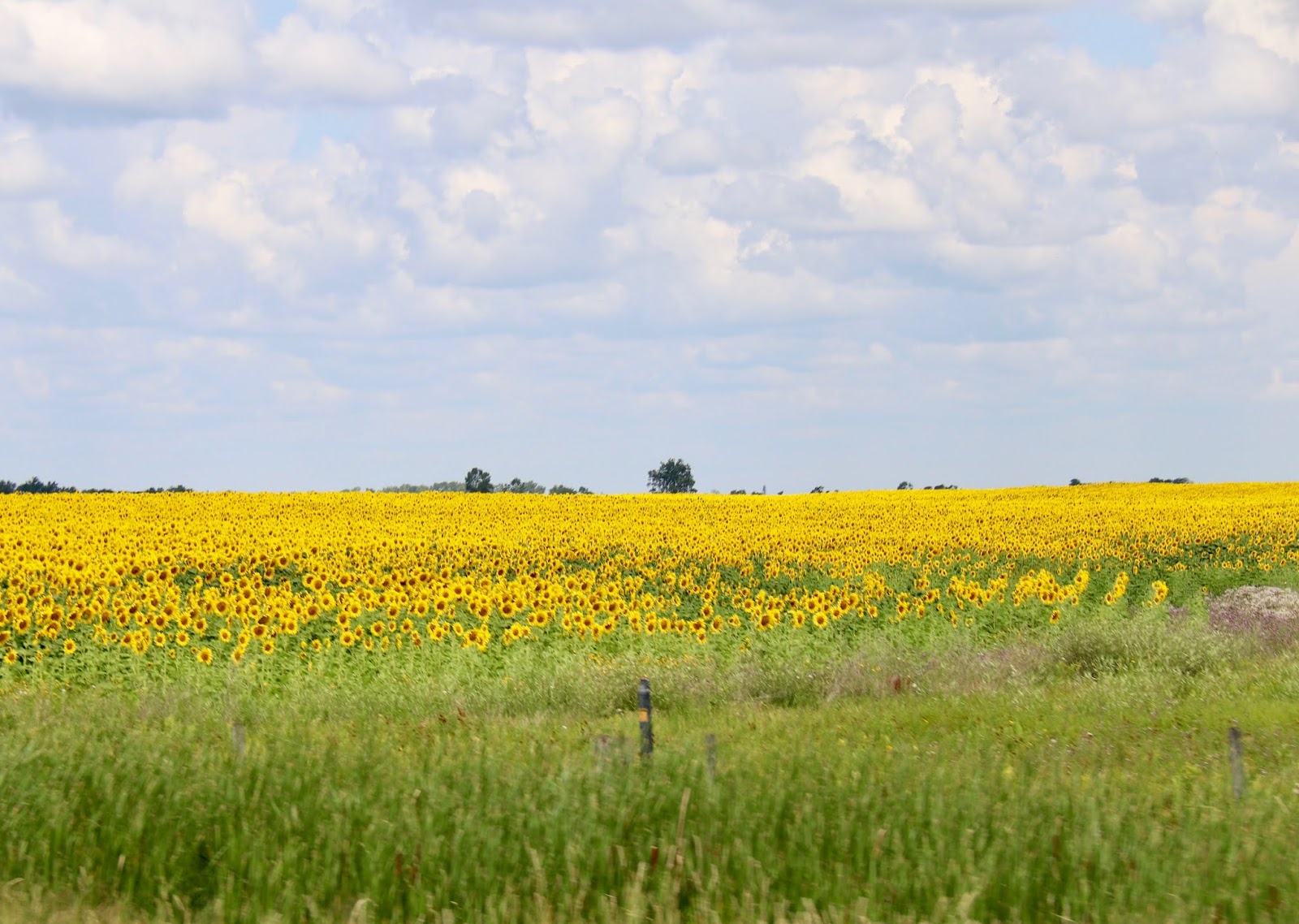
 As we traveled along, we passed fields with bison grazing lazily under the warmth of the sun and fields of the usual corn and beans.  We passed fields that were brilliant gold.  At first, we had no idea what on earth it could possibly be.  As we passed field after field, we finally could see that these colorful plants were actually Sunflowers.  Imagine that, Sunflowers here this far north.  We always imagined that they grew only where the weather is warm.  Learn something new every day.

The ride was such an easy one.  The road was straight as an arrow.  All we had to do was put the cruise control on and let the truck do the rest.  As we traveled along, we could see storms brewing ahead of us.  As we arrived at Prairie Breeze RV Park, thunder rolled promising rain and soon.  After a nice dinner of grilled steak with a bottle of red, we settled in for the evening.  Ahead, three nights and time to explore the surrounds.  We are looking forward to learning about the history of this area.  Tomorrow promises to be an adventure.

Friday, July 27, 2018

Rough Days Ended At Last

Since my last post, our journey has been challenging.  We traveled from Thorntown, IN to Elgin, IL, a day that undoubtably will stand as one of the worst in our RV traveling experience.  The trip should have taken us about four hours but instead was nearer seven.  Why you ask?  Because of road conditions and the route itself.  I suppose the challenge for the various DOT groups in this neck of the woods is keeping highways that suffer from snow and ice in the winter and heavy 18-wheeler usage in good order.  The general condition of the roads has been quite poor.  Yesterday our route took us smack dab through the center of Chicago, yikes!   We had road construction and repair, rough road surfaces, tons of 18-wheelers, heavy traffic causing stop and go conditions AND tolls. The I-90W becomes a toll road south of Chicago and continues to be a toll road close to the Wisconsin border.

In our experience of traveling through West Virginia, we have encountered toll roads.  The cost was set at $2.50 per toll booth.  Here, it was all over the place in cost.  It ranged from $1.90 to a whopping $24.40!  I stopped counting cost when we topped $30.00.  Okay, okay, I know I am venting so I will just say, at the end of that day we were played out!  Fortunately, our overnight campground was delightful.  We stayed at Burnidge Forest Preserve in the Paul Wolff Camp.  Our site was shaded and the surrounding area was beautiful and peaceful.  It was just what we needed after a hard day.  As much as we would have enjoyed exploring a bit, the only thing on our minds was a beer and to sit and relax..

We headed out yesterday morning early, hoping the journey would be better and it was much better.  We sailed along at a good clip on roads that were in good shape.  The scenery is beautiful if a bit boring.  There are miles and miles of corn for grain with a scattering of soy beans.  Never knew there could be this much corn but we learned it is the primary cash crop in this next of the woods.  The temperatures were in the mid to upper 70s with clouds that threatened rain but did not deliver.

We crossed into Wisconsin mid afternoon — land of Cheese Heads and Packers!  We were still surrounded with corn but here and there we began to see lovely rock formations. Our home for the next two nights is Country Villa Motel & Country Camping.  From the road, all we could see was the motel part and it looked deserted, mmmm perhaps we might move on?  Undaunted, we went to the office and rang the bell to be admitted.  We were greeted by a nice lady who was very helpful and gave us lots of ideas for things to do today.  Turned out that the camp was behind the motel set back in the trees.  It is small with only 22 lots, but our spot has plenty of room and is a pull through.  As we were setting up, the promise of rain finally materialized but was short lived.  Once we were set up and had a chance to rest a bit, we headed out to a family restaurant for a bit of dinner.  It was a no frills sort of place and the food was good.  For desert, we decided a DQ would fit the bill and it did for sure.  As we started back, another shower passed through leaving in its wake the most beautiful rainbow I have seen in years.  It was a double and I counted eight bands of brilliant color!  Alas, I had no camera of any sort to take a picture but I can tell you, it was wonderful.  A great way to end a good day.


Today we have a list of things to explore.  I promise to have pictures to post now that the corn is not the only thing I see.

Tuesday, July 24, 2018

Children of the Corn

In the early morning hours before the coffee brews and while all is quiet, I think about what the day will bring, all the possibilities of things we might find somewhere down the road.  As all the preparations for breaking camp are done, there is an excitement that comes each time we hit the road.  Today we would travel through Ohio and into Indiana, a journey of about five hours.

Well, all those wonderful thoughts began to sour as the day unfolded.  I read in the news how the infrastructure of our great country is in a sad state.  I cannot say that is true or false, however I can say that the roads we traveled today were for sure in need of a great deal of improvements.  The roads went from bumps and humps and potholes to washboards that jarred our teeth.  We kept thinking that everything in the rig would be scrambled eggs!  When pulling an RV, you can feel the road surface more acutely than in a car.  Each time the road surface went across the threshold of a bridge and off again, the uneven surface gave us a jolt.  Our expected 65 mile per hour average dropped to 50 or 55 and sometimes not that much.  Driving under these conditions is stressful and very tiring not only for us but also for the girls.

After seven hours of travel, our journey was nearly at an end.  The GPS gave us directions to turn on roads that wound through cornfields that stretched for miles and miles.  
 We laughed and started referring to ourselves as “Children of the Corn”.  In the middle of no where, the GPS stated “you have arrived at your destination”.  What?!?  We are in the middle of fields!  Now the real adventure began.  


We called the campground where we had planned an overnight to ask for directions.  We were told that GPS directions often took folks way off track.  She gave us vague directions to the park, no problem.  Rightttttt!  We backtracked and headed out only to find that the road we were to take was closed for repairs.  Okay, so let’s look at a real map, but where the heck are we exactly — no idea.  Funny how we have become so dependent on GPS that we forget how to plan a trip using paper maps.  Now, we have not one but two GPS in the truck.  One is built into the dashboard and the other is a Good Sam GPS specifically for RV traveling.  You would think we would be all set, geez what a stupid feeling.  Meanwhile, all that corn seemed to be closing in all around us!  In the end, we finally found our campground and settled in for the night.  Tired yes, for sure but also a bit wiser. A GPS is after all, just a machine.  It is up to us to have a plan B paper map to fall back on when the miracle of electronics fails.  Lesson Learned!