Monday, September 12, 2022

Day 6, Port Maimesbury

As has become the routine for us, we woke to rain and breathtaking scenery.  We have been in the Tongass National Forest since our trip started, so you can get an idea of just how large the forest actually is.  Within the forest are a number of wilderness areas such as Tebenkof Bay Wilderness — 66,812 acres and Kuiu Wilderness — 60,581 acres.  These beautiful wilderness areas are accessed only by floatplane, motorboat or paddle boat.  They are managed to continue the preservation of undeveloped, enduring ecosystems for future generations.  The Ocean Victory is one of only a few vessels that can access the most remote areas of these wilderness lands.

In today’s modern world, few have the opportunity to explore places no one else has visited.  Our Captain Jeremy and his expedition team decided to sail through Stephens Passage into a remote bay that is one such place.  Few, if any, small expedition vessels have ever visited this place.  Deep in the heart of the Kuiu Wilderness of southern Kuiu Island lies Port Maimesbury.  This isolated waterway will be our playground for this day.  Kayaks and Zodiacs will be launched and who knows what we will encounter.  There is a high sense of anticipation and excitement as we think of what we might find in these waters.


Kuiu lies between the islands of Baranof to the west and Kupreanof to the east.  It has about 700 square miles of nearly uninhabited terrain.  The 2000 census recorded only 10 human residents living in the area.  Land critters include black bear, moose and wolves.  Marine critters include sea otters, whales and other mammals.  There are of course, eagles living here too.  We can only hope to spot some of these during our day of exploration.


As our Zodiac departure was not until 1:30 this afternoon, we started our day with one of the science presentations. This one was all about the Tongass National Forest including hands-on science about Algae.  Our excitement was not particularly high but hey, we came here to learn and experience so let’s go learn something. The Tongass National Forest is an old growth forest.  By that I mean it has been in its natural state for hundreds if not thousands of years.  It is also a rain forest.  It is this abundance of rain that creates this lush environment rich with all sorts of life.  During the last ice age, as the glaciers moved forward, they scraped the land of soil down to the bedrock.  As it later receded, it left this barren rock exposed to the elements.  Slowly over time, mosses, lichens and other small plants began to grow, die, decay and grow again.  The cycles progressed until a thin layer of soil was created which in turn allowed bushes and other plants to grow, die, decay and feed the soil.  Trees began to take hold and grow as well.  Thus the Tongass was created over time.


Everything grows and supports life here.  The trees are actually only growing in about 24 inches of soil, thus the roots do not go down but rather spread out.  Trees are thus vulnerable to toppling over in strong winds or as the soil erodes beneath them.  The trees fall and begin to decay and feed the soil, but while this happens, mosses and lichens grow and cover the fallen trunk.  Everything is covered with life, everything.  If we could take a walk out into the forest, we would find a thick mass of all manner of trees and bushes and…well, life.  Mmmm, pretty neat.  But what about beneath the soil?


Well, beneath the soil, the trees roots spread and grow. Along with them are whole colonies of Algae and other micro organisms.  One such algae grows at the tips of the roots of the trees.  This algae spreads in communities and scientists have found they are able to communicate between themselves, not like we do of course but in their on way.  They benefit the trees.  If a tree becomes stressed and needs extra water and nutrients, the algae senses this and is able to send this needed nourishment to the tree.  Of my gosh, who would ever think such a thing is possible?  But what about what is in the water?


Well, the nutrients that the dead and decaying matter creates also flows in the rain into the water where it feeds the micro organisms living there too.  Small fish feed on the smallest organisms and then large fish feed and eventually the mammals like whales feed.  The whole circle of life thing keeps singing in my mind as I look around myself.  Life springs forth, dies and feed a whole generation of life and the cycles repeats.  Sort of like wash your hair, rinse and repeat.  Oh dear, I probably told you too much science stuff.  See, that talk was educational after all.


Our time to depart arrived and we hurried to get into all our gear and head for the launch area.  Almost immediately we encountered Sea Otters.  These little clowns are so cute to watch.  They float on their backs using their tails to propel themselves forward.  They love shell fish and sea urchins especially.  They are smart and have developed a number of ways to open the shells.  They have been known to bash the shells against the sides of boats to break them open.  At an early age, they will find just the perfect rock to use to crack the shells. When not in use, they will store the rock under their arm until needed again.  Pretty cool!  The mothers carry their babies on their stomach and swim around like a magic carpet for the babies to ride.  It makes us laugh to see them.


In the distance, we began to see the now familiar plum of spray made by whale’s exhaling.  We turned our zodiacs toward the open ocean at the mouth of the bay ad opened the throttle.  Seeing a whale on a film or TV program or from a beach or cliff is one thing, but being on the water with them, well that is awesome!  As we approached, we could see more and more “blows” indicating that there was a number of them hunting together.   Suddenly, a whale rolled through the water quite near to our boat so we stopped to wait and see where it would go.  Alaska protects the whales and one cannot chase or come closer than 100 yards of these behemoths.  However, if the whale comes to us, well that is okay and a thrill.

We interacted and watched them for quite some time.  It was thrilling to see them roll through the water arching their humped backs and flipping their flukes (tails) as they dove down in search of prey.  Here they are hunting for schools of small fish.  It had gotten quiet and suddenly, without warning right beside our boat three whales broke the surface with their mouths agape swallowing fish by the hundreds.  They crashed back into the water leaving water and foam and our squeals of excitement behind.  Oh my gosh, what a thrill!  This was one of three such actions we saw while we were on the water.  I thought my heart would beat out of my chest!


All too soon it was time to return to Ocean Victory.  I can tell you, I will never forget this day for I feel we have danced with the whales!


Day 5, Petersburg

After a fitful night’s sleep, I woke to the sound of rain.  I pulled back the curtains to reveal fog, mist and a grey, sleepy looking day beginning.  Every fiber of my being just wanted to roll over and go back to sleep but I knew we would regret not taking advantage of the day’s activities.  I nudged Jim awake and we made preparations to go up for coffee and breakfast.  We had to be ready for our Zodiac ride ashore by 9:30 a.m.  Groan, yawn, up and at it.

Today we will visit Petersburg.  Large cruise vessels cannot come into this shallow. protected harbor.  Petersburg is home to Alaska’s largest home-based halibut fleet.  So, Ocean Victory passengers are privileged to have the opportunity to enjoy this authentic Alaskan village.  This tiny, charming town was incorporated in 1910.  The abundant waters and endless supply of ice from the nearby LeConte Glacier brought Norwegian fisherman, Peter Buschmann to this area where he built the regions’s first cannery. Buschmann invited many of his countrymen to join him in establishing this town, hence the name and strong Norwegian culture.


The population of Petersburg is 3,100 people.  It has remained stable with fishing still the main source of income.  The 3,100 people are supplemented with seasonal workers, deckhands and fishermen who come to help with the cannery.  Their fishing is not just a single specie affair but rather they adjust and change their methods depending on the time of the year and the type of fish that is in the waters.  By that I mean they may seine fish, net fish, long line and even dive for sea cucumber and other things.  It is hard work but very profitable.  A person could earn 30K in one summer season.  Lots of college students come and work.  The payoff is they can finish college with no debt!  Pretty cool.


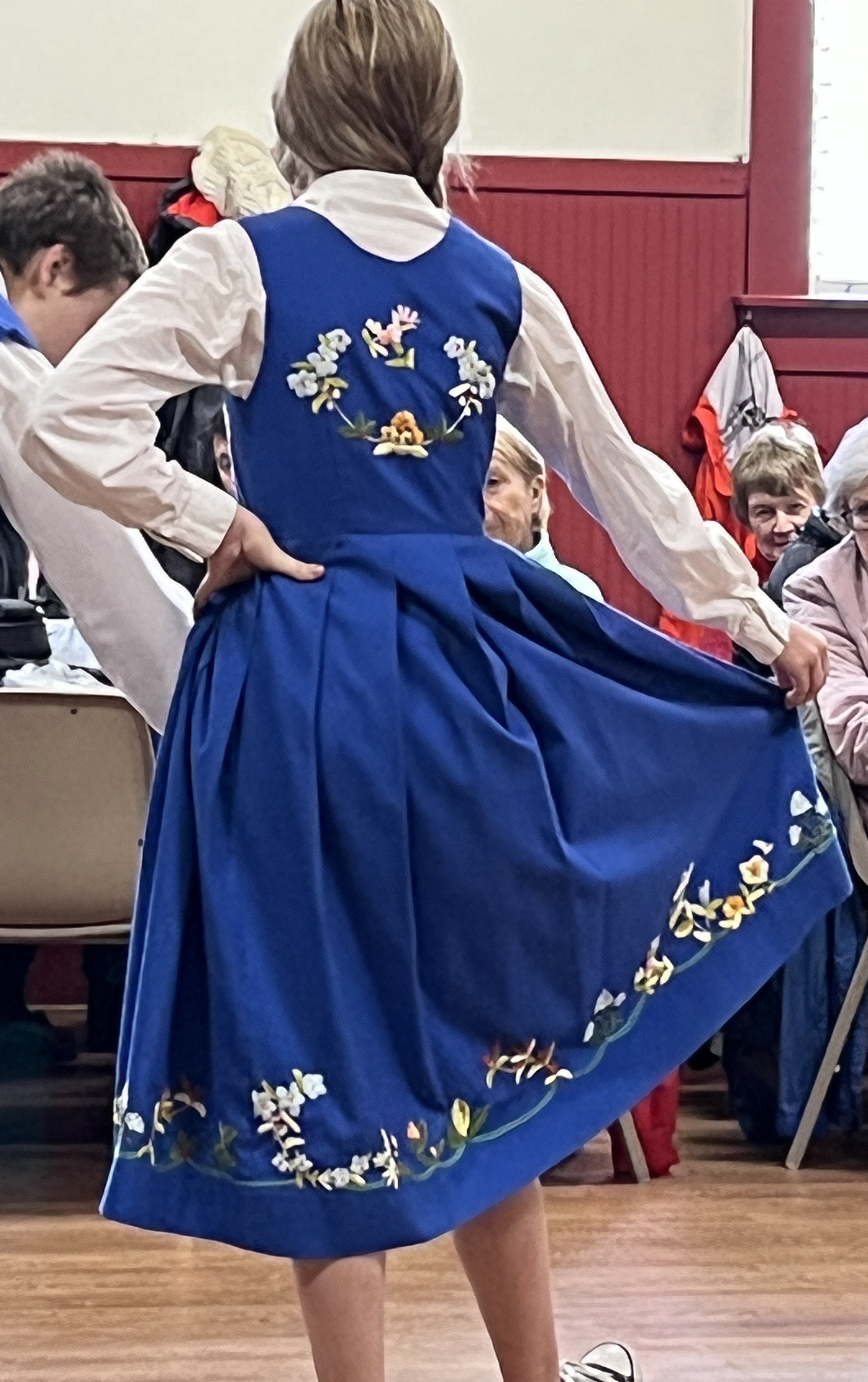
Our first stop was at the Sons of Norway Hall to enjoy the culture and cuisine of Alaska’s Little Norway.  The hall was built in 1912 as a community hall and serves the community for all sorts of events from marriages to life celebrations.  We were treated to some of the sweet treats and tea.  Then Leikkaring Dancers performed a selection of Norwegian dances for us.  All the dancers were 11 to 13 years of age.  The dances were folk dances with intricate steps and twirls.  After the dancing, our host told us of the history of the town and then opened the floor for questions.


It was so refreshing to listen to the children answer questions about what they like to do and what they planned to do with their lives.  The majority of them want to return after college and live in Petersburg.  When asked about what they liked to do, instead of talking about dancing and listening to music or playing video games, they spoke of camping, fishing, ice skating and other outdoor activities.  Most of the kids do not even have a cell phone until they reach eighth grade.  There was an innocence about them that was refreshing.


We spent the rest of our time exploring this quaint town and shopping about.  We stopped for a bowl of hot soup at a tiny little place.  It was hot and thick and yummy.  The owner was an Asian lady who could not have been more than 4’10” tall.  She was quite a ball of fire.


Another place we stopped was a small park of sorts.  It told the history of Petersburg and the fishing industry that has kept it alive for all these years.  It has not been easy for sure.  There has been a rise and fall of companies in the fishing and cannery industry but as one went out business, another took its place.  The industry has changed as well.  No longer is the Salmon strictly packaged in cans.  More modern vacuum packing is use today to not only save on weight and cost but also to extend the shelf life of the contents.  It is also sad to note that the founder of Petersburg after all his hard work, ended up penniless and ended his own life.  Life can certainly be hard out here, but his hard work lives on in Petersburg and life of those who call it home.


This mural was painted on the side of one of the building.
                            It depicts an idyllic version of Petersburg.

We returned to the Victory about mid-day ready to relax and enjoy doing absolutely nothing!  Tomorrow will be another expedition day.  I am sure we will be busy.


Wednesday, September 7, 2022

Day 4, Stephens Passage

After such a wonderful day at the glacier, it was time to head for our next spot, Holkham Bay.  It has another name, Sumdum Bay named after the nearby hanging glacier.  It serves as the gateway to the wilderness area we were in the previous day.  This vast wilderness area spans over 653,000 acres of glacially carved fiord and steep cliffs.  The Sumdum Glacier is a hanging glacier, and we could see it from our balcony.  A hanging glacier is one that has receded and no longer touches the water.  It is also home to many marine mammals including Humpback Whales and several seal species.  We sailed through the Stephens Passage where Humpback whales are known to come.  They search these nutrient-rich waters to feed on tiny creatures like krill — shrimp-like organisms and small, schooling fish like herring.  These behemoths of the sea can reach 40-feet in length and weigh 40,000 pounds.  Who knows, we might even see sea otters, or even an orca or two. 


The Captain and the Expedition Director had decided to linger here for the day and give us all time to search for and view animal life.  One of the great features of this type of cruise is that we can change our plans on a whim and the boat can be maneuvered much more nimbly than the larger ships.  The water was pretty calm so first off the Kayaks were launched giving all those hardy souls their first taste of paddling across these waters.  We watched as they left the boat and headed toward the nearest island. We would love to kayak however, knees etc. just won’t allow it.


We were happy to hang out on our balcony and watch the scenery roll past.  Of course, there were talks planned and we joined our new friends for one on binocular usage.  At first I thought it was a silly idea for a talk.  But I was wrong.  I have never felt comfortable nor been successful using them. In this beautiful place, they are great for spotting wildlife.  By the end of the talk, I found I could adjust them and bring into focus the world before me.  Who would have thought?


Later, there was a discussion about using cameras both cell phone cameras and regular cameras.  Now this one we really wanted to attend.  We were not disappointed either.  We learned a number of tricks and discovered several functions we had no idea were there.  Funny, modern technology is wonderful but most of us do not fully know how to use it.  In the midst of the talk, the loudspeaker announced, “whales off the port side”.  As you can imagine, the talk was put on pause as everyone hurried to nearest viewing point.


We chose to go up to the open deck 8.  At first, all we could see was the “blow” as the whales surfaced to take a breath.  Suddenly, a whale emerged from the water and came crashing down with a huge splash.  Almost immediately, he breached and gave us a great view of the fluke or tail.  There was a group of them including adults and juveniles.  The Captain had maneuvered the Victory to bring us around and came to a stop so everyone could have a closer look.  The whales circled around one side and continued to breach and roll and slap the ocean with their flippers.  It was quite an exciting show.  Finally, I stopped photographing and just stood and watch in awe of the wonderful creatures, after all the mind is the best camera of all.


Back inside, the talk resumed.  Since 90+ percent of the passengers are seniors, there were lots and lots of questions.  It was a challenge for our speaker given there were all sorts of phones from Android, Google and iPhones as well as late, new and older than dirt!  Too funny.  But he handled all the questions with the patience of Job.  Before he finished, again the speaker announced, “Seals off the port side.”  The rush was on to get outside to catch a look at these Sea Lions, not Seals.  I am lucky to have a zoom lens so most of my pictures do show the Lions clearly instead of looking like brown dots on the shore line.  There were dozens of them hauled out sunning themselves.  You could hear their barking as and squabbled among themselves.  What a treat.  Again, the Captain had maneuvered the Victory closer to the island to give everyone the best chance to see and photograph the group.  What an amazing boat the Victory is for sure.  He can actually change the ballast when they are launching the kayaks and Zodiacs to bring the launch opening down to the level of the boats.  Pretty cool.


Finally time came for the Captain to head out in the direction of our next stop.  Tomorrow we would visit Petersburg, Southeast Alaska’s Little Norway.  But first, another sumptuous dinner and a good night’s sleep.


Sumdum Glacier


Whales Ho!


And then there were seals.

Day 3, Sawyer Glacier

Sometime before midnight, I heard the sound of the ships anchor going down.  This sound signaled that we had arrived at the Tracy Arm-Fords Terror Wilderness.  This wilderness can only be accessed by boat or floatplane.  We had been told that we would stop here and anchor until daylight as there would be ice and it would be dangerous to try and navigate after dark.  When I woke, I pulled back the night curtains and gasped at the sight.  We had moved into either the Tracy or the Endicott arm. Steep rock walls with waterfalls towered above us.  In the water, a large piece of iceberg floated past.  The berg had areas of deep blue glacier ice gleaming in the sunlight.  Gosh, what a sight to wake up too!  I rushed to get on clothes so I could go out on our balcony and take pictures.


About 75 percent of his area is considered alpine.  The temperatures are mostly mild with some snow during the winter months.  The remaining 25 percent consists of glaciers and snow fields and the temperature is much colder.  It is managed by the US Forest Service in order to preserve this undeveloped ecosystem for our future generations.  The Forest Service states, “Behold primordial time itself:  a glacier reminding us of an ice age that began over a million years ago.  Across the millennia this condensed ice flowed down from the mountains grinding granites into flour.  Today the glacier retreats as it calves icebergs into the sea and continues its centuries-old unveiling of the dramatic fiord it has sculpted.”


As I stared out at the view, I am touched once again by the beauty all around us.  It is a dynamic scene.  The slow moving often crumbling ice supports all sorts of life.  Harbor seals come here to deliver their pups.  Within minutes, the young pups flop about on icebergs where they are protected from marauding Killer Whales.  Eagles swoop down to grab the afterbirth or even possibly the young pup itself. The mother maneuvers to protect her newborn, pushing it into the water where the awkward baby is transformed into aquatic grace.  The ice leaves behind it fine granite “flour” a byproduct of the constant grinding of the ice and rock.  This flour gives the water its milky green color.  It is full of nutrients that feed the ocean and the land and all living things in and on them.  It is a place of wonder.


We stayed on the balcony for a long time taking pictures and just watching the “living movie” pass us.  Gradually, the Ocean Victory slowed and then stopped.  Over the loud speaker came the announcement that we had stopped before the South Sawyer Glacier.   We raced up to deck 8 and joined our fellow travelers outside to view the sight.  I have seen glaciers before but it was still a thrill.  We were a little over a mile from it.  The varying shades of blue and white ice towered up the mountain side.  This is a tidewater glacier meaning it ends in the water.  They are known to calve frequently.  Calving happens when cracks appear in the ice eventually causing a thunderous boom when the ice falls away in a tremendous splash. It can be quite dangerous if you are too close to the glacier when this happens.  Close to the face of the glacier, we could see tiny black dots or flakes.  These are Harbor Seals with their pups.  Oh how I wish we were close enough to see them clearly.  But even if we were, seals are shy and will seek refuge in the ocean if we approach.  We were told if we see them and they drop below the water, turn and look behind you as they will often pop back up to take at look at you!


Because the ice in front of the glacier was dense and packed, it would not be safe to launch the Zodiacs or kayaks.  So, our Captain had decided to backtrack and go to the other arm and the North Sawyer Glacier.  As we maneuvered a u-turn to head back, we all went inside seeking coffee and breakfast.  After breakfast we had an interesting talk about all things glaciers.  The presenter used “flubber” to demonstrate how the glaciers move down the mountains and the impact they have upon them.  It was funny when he talked about how flubber was made including borax, “whatever that is”.  Too funny!  All us seniors know perfectly well it is a laundry product.  We had a good giggle.


Obviously, 130 passengers could not possibly board boats all at the same time.  So, we were divided into groups with animal names — wolves, seals etc.  We are seals.  After lunch we finally got the call for all seals to assemble to board our Zodiacs.  Jim and I were bundled in multiple layers of clothing topped with rain gear — it rains off an on a lot.  We boarded in groups of 10 with a guide or two and headed off for the glacier.  The wind was icy cold as we zipped along.  We pulled up close to one waterfall to experience the way wind changes the closer you get to the fall.  The water spray pelted our faces like a spa treatment.  Everyone laughed and enjoyed the experience.


We finally arrived at the terminus of the glacier.  A hush fell over everyone as we took in the sight.  This is the first time we have been this close to a glacier and it made us feel like tiny ants.  A seal popped up in the water to take a look at us before dropping away.  The guide talked about the ice and pointed out places where it had carved out lanes in the surrounding rocks.  Some of the ice was covered in fine dirt making it look like rock.  Suddenly, there was a loud crack and a huge piece of ice sloughed off and came crashing down into the water.  It created a large wave that rushed out in our direction.  We were far enough away to be safe but still felt the upheaval of the water beneath us.  What a thrill!


All too soon it was time to return to the Victory.  What a thrill the experience was for us.  Back on board, there were cocktails and dinner and stories to be told.  By the end of dinner, fatigue set in and we headed up to our cabin to relax and sleep.  It had certainly been a day that would live in our memories, cataloged with so many others.  How lucky we are to have such a wonderful experience.


Breathtaking view of wonders to come.


All around are waterfalls, a benefit of lots of rain.


Happy Faces all bundled up from the extreme cold.


All the views of the glacier, one of nature’s most powerful forces.

The darker blue ice represents the newer exposed ice, a product of calving.  The final picture is of the calving.


Day 2, KaKe

It seems that we have been on the move ever since arriving onboard.  This is an expedition cruise, not a pleasure cruise. There is a great deal of focus on educational and cultural learning.  We will be having expedition days when we will go out on either kayaks or Zodiacs to get up close and personal with nature, whether it is glaciers or sea life or even animals.  As you can imagine, there is a great deal of focus on safety.  So, we did drills on how to prepare to go out on the Zodiacs.  We met all our expedition staff.  They are mostly young Cal Poly grads, all with  degrees focusing on scientific specialities. They will teach and share with us as we explore in the coming days.  Very exciting for all.


Of course there was a great meal with a variety of entrees and a free flow of spirits and wine.  One of the nice things about this cruise is there is a large list of complimentary drinks, alcoholic and non-alcoholic eliminating the pressure to purchase packages.  The same is true for the  excursions on the non expedition days.  There is a full compliment of excursions that are complimentary and also some premium ones if you choose to go that route.  All of this makes it very easy for passengers.  For sure, there is plenty to eat and drink all day long, guaranteed to add a few pounds if one is not careful.


We met two couples, one from Texas and the other from Oregon.  They are funny and fun to be with and we have become a “group” sharing activities and meals.  It makes the trip more fun in a way but on the other hand, we miss opportunities to meet others.  Most of the people we have met are well educated, well traveled and well monied!  But the common thread of all is a love of life.  But I digress.


Our first port stop was KaKe (pronounced cake).  The community has about 500 residents, mostly native Alaskan. A representative of the community came onboard to welcome us to their community.  She spoke to us in Tlingit first and then translated into English.  It is quite a complicated language with a wide range of sounds — harder than Chinese!  She shared with us how their culture and language was nearly completely lost.  Over the past ten years, there has been a drive to return to the culture and teach the youth the language.  She shared how each family lives a mostly subsistence life style; hunting, fishing and gathering the bounty of the land including under the sea.  It is not an easy life but one that involves everyone in the family from the oldest to the youngest.  She wore a vest that is decorated to represent the tribe she belongs to and the larger tribal connection of her mother.  She also brought a tribal drum and sang two songs for us.  As she sang, you could see the emotion of the song written on her face.  Clearly, they spoke about family and the history of their people.


Afterward we climbed into the Zodiacs and headed ashore.  First off, we went to the community center where a variety of locals were there displaying and demonstrating their various crafts.  One lady created the beautiful vests and other costumes worn when they sang and danced.  Another demonstrated how they gather the materials and prepare them to be woven into baskets and other implements.  Another worked with hides of animals such as the Otter.  She had beautiful hats and other things.  I fell in love with a “bucket” hat that was lined with foe fur, guaranteed to be warm.  I am sure it will keep my head warm when we visit the glaciers on the Zodiacs tomorrow.  Last but not least was an artist who was demonstrating how to make a traditional drum.  There is respect for the culture and customs in everything they do.  Before making a drum, one must get permission from the elders to do so.  The one he was making was from the hide of a deer.  When it is completed, one of the young girls will paint traditional symbols like the Orca or Eagle on the face of the drum.  The drums can be any size from 12 inches to 36 inches depending on the size of the hide.  It was quite interesting.


Next, we walked down to the freshwater stream where the Salmon were running.  We hoped as we walked that we might see a bear fishing.  The run is nearly complete so the likelihood was slim but we had hope.  There is a Salmon processing company on the island and is one of the main job sources.  So Salmon is very important for the economy as well as for subsistence.  As we reached the bridge over the stream, we could hear others saying there, there.  Sure enough,  a young black bear was making its way down to the stream.  At first, he seemed likely to run back into the woods because all the noise from the group was loud.  But finally, he just slipped into the water and swam to the other side where he hauled out and ambled upstream away from all the noise.  We did not get to see him fish but we saw a bear in its natural setting.


We headed back to the Zodiac to return to the boat.  On the dock a fisherman was cleaning and filleting two Halibut.  Each one weighed about 110 pounds.  They would provide some income as well food for the family.  With all the walking we had done, we were ready to relax and have a cocktail.  It had been such a good day and tomorrow promised to be even better.  During the night, we would sail a distance to the Tracy Arm-Fords Terror Wilderness area where there are several glaciers.  There we would anchor until morning as sailing in the dark with so much ice around is dangerous.  It will be an expedition day and we will get up close and personal.


Our Hostess


                                                KaKe in the distance


This vest represents the klan of the Raven.  Notice how the beak is shaped.


This vest represents the klan of the Eagle.  Notice the shape of the beak.

My bucket hat with the artist who made it, Faith.


Finished traditional drum.  It is held in the hand and beaten with a mallet.

Black Bear making his way down to the Salmon stream.
  
Bear swimming across the stream.


Saturday, September 3, 2022

Bears, Bears, Bears

When you visit Alaska, one of the things high on your list of things to see is bears.  In the Sitka area, bears live in close proximity to humans.  Usually, the interaction between the two is minimal.  During Covid, human interaction decreased to nil.  So much so that when Covid restrictions were lifted, the bears had reclaimed their full territory and clashes began.  Last year, there were more bears killed by automobiles than ever before and many bears had to be put down because they were being a nuisance.  Even so, they are important to the culture and traditions of the Alaskan people.


In Sitka, there are no black bears.  Only brown bears are indigenous.  Grizzlies which are a subspecies of brown bears are not found here but rather are inland. Each year, a number of bear cubs or injured bears find themselves in need of help.  For years, the only answer was to euthanize them as without their mothers, they would starve to death.  Now these helpless animals have a sanctuary, Fortress of the Bears, where they can go to receive care and live out their lives.  As the center gets more bears than they can handle, they are placed in zoos who are seeking to add or replace their populations.  The ultimate goal is for them to receive all the permits etc. to allow them to have a release program.  The cubs especially should be able to be release back into the wild and live a normal bear life.


For now however, they live in a wonderful habitat and are cared for by professionals.  The young cub are placed with one professional who becomes a surrogate mother.  It takes a bit of time for the frightened cub to imprint on their new mom, but once it happens the bond is strong.  That person will feed and train the cubs until they become juveniles or get too big to handle safely.  Then they are placed into one of the enclosures with other bears.  The handler continues to have contact with the cub, but less and less over time.  They train the bears to do simple things like stand up, hold up a paw or open the mouth.  Why?  This allows the handlers to inspect the paws and other body parts for disease or injury without having to handle the bear.


Our visit there was amazing and the bears, majestic.  They had a section dedicated to three black bears that were brought here from outside the area.  Black bears love to climb trees and hills as well as swim, so their area was created to give them that environment.  Brown bears love to swim so their space has a large swimming pond.  They place live Salmon in the waters so the bears can hunt and catch their food.  Of course, they are given other food as well.  These other foods often are laced with vitamins and other supplements to ensure they remain healthy. It was truly amazing to see the beautiful creatures.


At the end of our bear visit, we were finally taken to the Ocean Victory.  There was security to go through, and passport checks and other check-in necessities to complete and finally we were on board.  We were treated to hot soup and other snacks including punch with or without champagne.  We had just enough time to unpack and get somewhat organized before the required safety drill.  We donned our rain gear and grabbed our life jackets and headed up to the appointed gathering place.  I had to laugh at how many of our “old farts” had not listened and followed instructions.  Some had nothing, some only had life jackets and one lady only had on socks but no shoes!  We had to go outside in the pouring rain to stand by our life boats and wait till the all clear was sounded.  Mass confusion.


Back inside, we got warm and dry before heading up for an informational talk about what the next days would have in store for us.  At the end of the talk, we saw our first whales in the distance.  Yippee, whales!  Then at our first dinner we were treated to a beautiful rainbow just as the sun was setting.  Finally we are back in our room, tired but oh so ready to greet the day tomorrow.  I wonder what other adventures we will enjoy.


Leaving Sitka

It is actually our third day of traveling and it is time to leave Sitka and board the Ocean Victory for our sea adventure. Before leaving, we visited the Salmon Hatchery.  It goes without saying, Salmon is a big industry for Alaska.  It is unfortunate that mankind will fish or hunt animals until they are near extinction.  Salmon suffered much the same fate, however the Alaskan government stepped in and gave them a helping hand.  At the hatchery, they have created an environment that is as close to the natural process of Salmon spawning as possible.


  Salmon are both salt and fresh water fish.  They begin their lives in fresh water, live in salt water through their adult lives and when it is time to spawn, they return to the fresh water where they were born.  So, the hatchery was placed where fresh water flows into the sound that is salt.  They simulated how the Salmon struggle to get up stream by building a series of “steps” that the fish must struggle to swim up, pretty ingenious I’d say.  Each of the different species of Salmon arrive to spawn at a different time in the season.  As they gather just outside the entrance to the “fresh stream”, you can see them rolling and jumping in the water trying to gain access.  They sample the females to see when they are ready to spawn.  You can stroke their bellies and if they are ready, the eggs are free floating inside.  Once the net that blocks the entrance is removed, they swim up the stream and jump up the steps in the same manner they do in the wild.


At the end of the steps, they are scooped from the water and euthanized by smacking them on the head with short, plastic bats.  Sounds inhumane but it is actually quick and painless. Next they take a knife and slit open her belly and the eggs flow out into a five gallon bucket.  The males are compressed to express the sperm into the full bucket and agitated to make sure all the egg get fertilized.  And that is that.  In the wild, the fish die once they spawn so killing them during the process is not unnatural. The dead fish are sold for pet food and other things as they are not good to eat once they begin the spawning process.  The fertilized eggs go to a series of tanks where they hatch and grow until they have reached the stage where they make a change to prepare themselves for salt water.  Then they are released.


It is quite the process.  In the wild, only 5-10% of eggs get fertilized and make it back to the ocean.  At the hatchery, 95-98% of them are fertilized and returned to the ocean.  Thus, the fish have made a remarkable comeback and the fishing industry is thriving. You may ask, isn’t this farming the fish?  No, because they follow the natural process and return them to the ocean where they eat their natural food and are a part of the circle of life.  With farming (which is illegal in Alaska) the fish are kept in captivity from spawn to table.  It was a very interesting visit and I came away with an appreciation of the work that goes into helping nature thrive.